



If you’re responsible for capital equipment decisions at a veterinary practice or hospital group, you’ll know that the conversation around MRI usually starts with the clinical team and arrives on your desk with momentum behind it.
The surgeons want it. The neurologists want it. The referral vets want it.
Your job is to ask the questions they may not have fully answered:
- What does it actually cost to operate, not just to buy?
- What happens when something goes wrong?
- What does the workflow look like? Who runs it?
And, critically, does the return justify the investment?
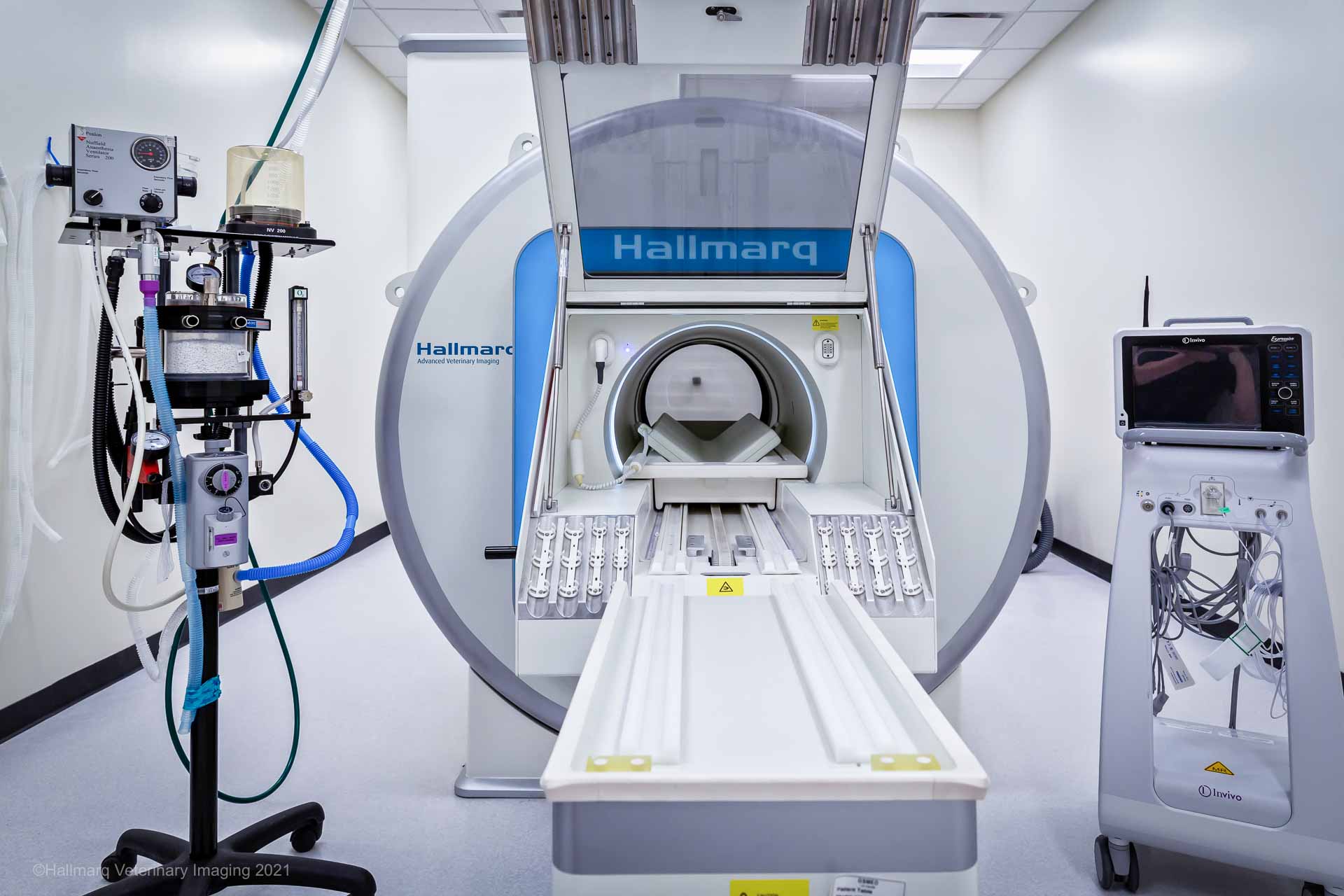
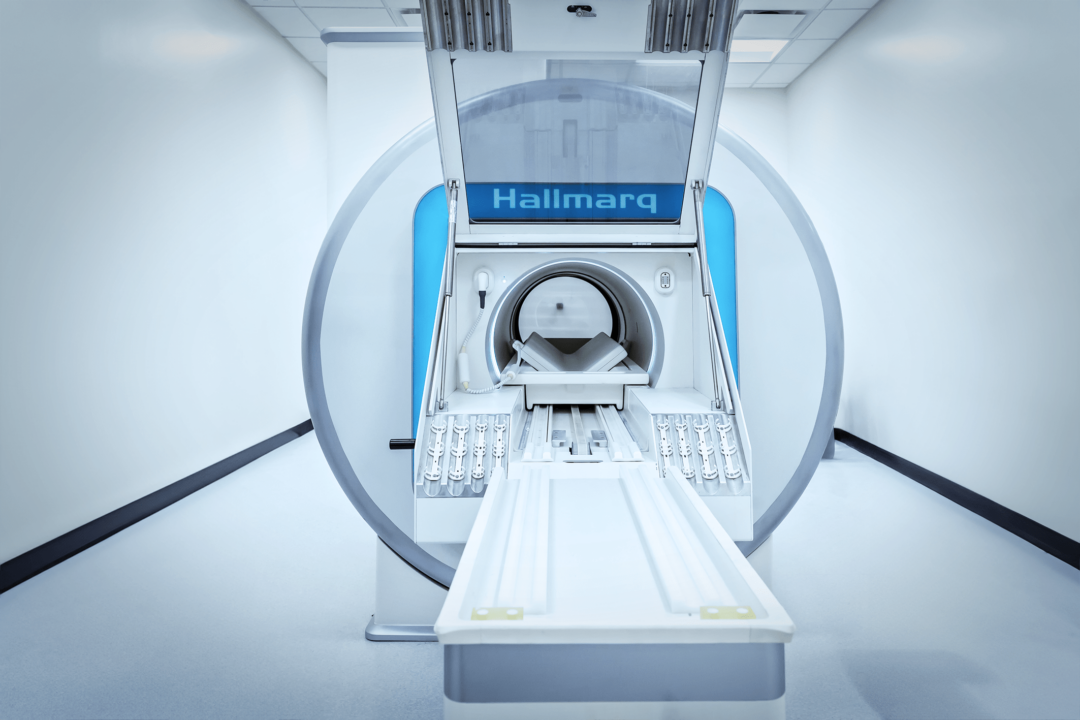
This is for you. What follows draws on the Hallmarq Small Animal 1.5T MRI – a system designed, from the ground up, specifically for veterinary medicine – and addresses the questions that matter most at the procurement stage.
Why MRI and Why Now?
Advanced imaging has moved from specialist luxury to competitive necessity in secondary and tertiary veterinary care. Pet owners increasingly expect the same standard of diagnostic capability for their animals as they would for themselves and the practices that can deliver it are pulling ahead.”
Mick Crosthwaite, CEO Hallmarq Veterinary Imaging
MRI is the foundation for in-house neurology, complex orthopedics and high-value diagnostic work-ups. A practice without it refers cases out. A practice with it keeps them in, captures the downstream revenue – surgery, follow-up imaging, ongoing care – and builds the kind of reputation that attracts more of the same.
Every MRI case that leaves your practice is a case that benefits someone else’s P&L. For high-volume neurology referrers in particular, the calculus is worth running carefully.
The Six Questions Decision-Makers Ask
1. “What Will it Actually Cost Us?”
This is almost always the first question and it’s the right one, but it needs to be asked about the whole system, not just the purchase price.
Traditional MRI systems, adapted from human medicine, carry significant hidden costs that are easy to underestimate at the procurement stage:
- Helium. Conventional 1.5T MRI systems require liquid helium to cool the superconducting magnet. Helium is a finite, non-renewable resource with a volatile supply chain and rising prices. A single unplanned quench event (where helium rapidly boils off) can cost as much as $150,000 to refill. That’s a single line item that most capital models don’t adequately account for.
- RF shielding. Human MRI systems require a purpose-built shielded room to prevent electromagnetic interference from distorting images. Site preparation costs (including the shielded room construction) can run to $100,000 or more before the machine is even delivered.
- Installation complexity. Quench pipes, oxygen monitors, specialist electrical supplies and extended build programmes all add cost, time and operational risk to a conventional installation.
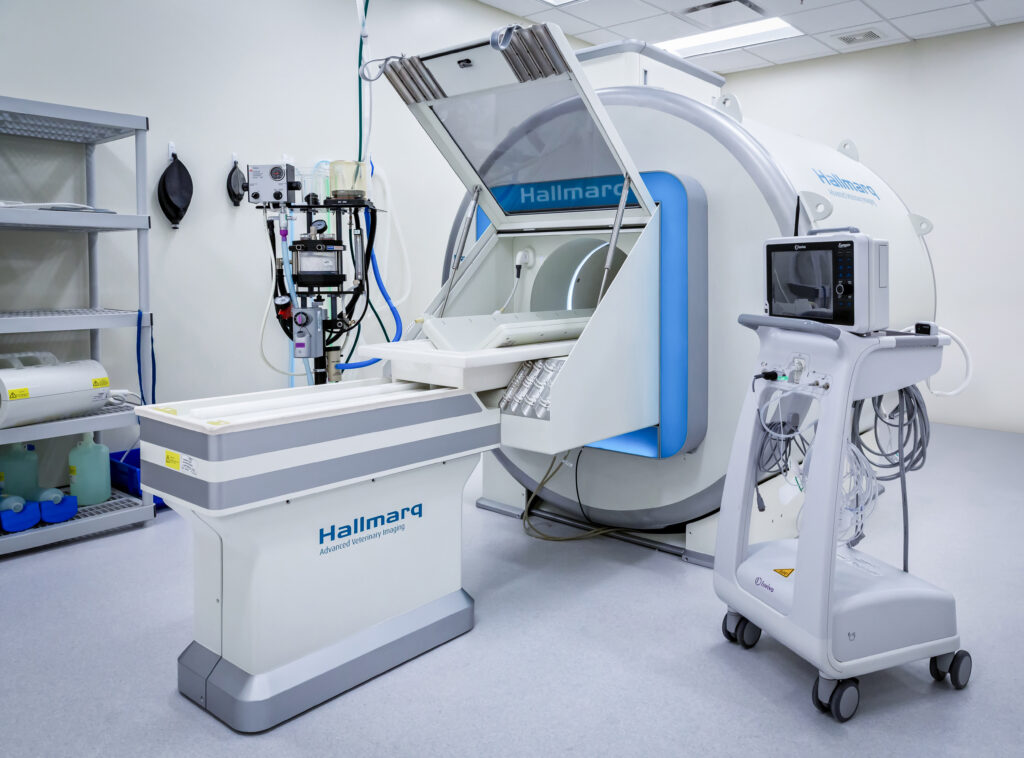
The Hallmarq Small Animal 1.5T MRI eliminates all three. It is 100% zero-helium: no refills, no quench risk, no oxygen monitoring requirement, no quench pipe. It has a built-in RF shield – a design feature unique to Hallmarq’s veterinary-specific build that human systems cannot replicate. And it’s available as a temporary building or ‘modular’ solution which requires no building works on your behalf. It’s simply dropped into place externally to your main building and operational in weeks rather than months.
The result is a materially lower total cost of ownership and a financial model with fewer unpleasant surprises.
2. “What Are Our Finance Options?”
Capital commitment is often the single biggest obstacle to MRI acquisition, particularly where cash flow is variable or resources are being allocated across competing priorities.
Hallmarq offers two distinct routes:
- Imaging-as-a-Service (rental). A single monthly payment covers everything: the system, service, support, training and remote operations capability. There’s no large upfront outlay, no loan facility required, and no requirement for a personal guarantee. The headache of how to finance your advanced imaging service is removed Treated as a P&L operating expense rather than a fixed asset, it simplifies the financial planning for practices with variable scan volumes or growing caseloads.
- Capital purchase. For practices that want asset ownership and the associated P&L benefits, outright purchase with a monthly ongoing service and support fee is available.
Both routes remove the financial model as a barrier and allow the decision to be made on clinical and commercial merit.
In addition, Hallmarq’s comprehensive Q-Care customer program is included with either option. Unique to Hallmarq, Q-Care covers: upfront planning and initial onsite training from in-house experts, system support and remote monitoring from our world-class Customer Success Team, marketing support for system launch and ongoing promotion, and account management to help maximize scan volumes.
3. “What if Something Goes Wrong?”
Unplanned downtime is a critical risk factor that decision-makers should pressure test hard. An MRI machine that is out of service is not just a cost centre, it’s a revenue gap, a client disappointment and an operational headache.
Hallmarq’s Q-Care program backs its systems with a 99% uptime guarantee. That commitment is company-wide, not a sales talking point. It encompasses remote system monitoring, on-site engineering support and the infrastructure to identify and resolve issues, often before the operator is aware of them.
The Remote Operations Service (ROS) addresses a different but related risk: staff availability. If your trained MRI operators are unavailable – through illness, scheduling gaps or high patient volumes – Hallmarq’s certified MRI technicians can operate the system remotely, maintaining scan quality and throughput regardless of what’s happening on your rota.
As Dr Baye Williamson, DVM, DACVIM (Neurology), at Veterinary Emergency + Referral Center (VERC) in Hawaii, describes it:
“Remote Operations removes the headache of always having our own trained technicians available to scan. Hallmarq’s Techs know how to maximize image quality and minimize scan times which is a huge benefit to our busy practice.”
For a procurement manager, this matters: the risk profile of the system is lower than a comparable offering without guaranteed uptime or remote operational cover.
4. “What Does the Workflow Look Like?”
MRI is more complex to operate than ultrasound or digital radiography. Decision-makers are right to ask how it integrates into an existing practice, what it demands of staff and what the realistic throughput is.
Hallmarq’s system is built around veterinary workflow, not adapted from a human hospital environment. The V-shaped patient bed and veterinary-specific coils – designed around small animal anatomy, not human anatomy – means the patient prep and positioning process is intuitive for clinical teams already comfortable with small animal handling. The 60cm bore accommodates all breeds. Video patient monitoring with LED lighting means the operator has full visibility throughout.
Training is comprehensive and ongoing. Hallmarq provides initial on-site training, access to its online community and 4 extra days of training per site per year included as standard. The learning curve is manageable and the support infrastructure around it is designed to keep it that way. Additionally, account management is offered to help support scan volume growth.
On throughput: With the Hallmarq business model, you can expect to break even at just two cases per week after which, the system begins to pay for itself. Any caseload over and above just two per week is where you start to see the return on your investment. Of course, each case opens further diagnostic and treatment pathways that generate downstream revenue.
5. “Is it Actually Clinically Good Enough?”
This question usually comes from procurement managers! They’ve heard clinicians make the case for brand name MRIs like Phillips or Siemens and want to understand where Hallmarq sits relative to those alternatives.
The answer is grounded in clinical evidence. The Hallmarq Small Animal 1.5T MRI delivers 1.5T field strength – similar to many human hospital systems – with veterinary-specific coils, sequences and software that are optimized for small animal anatomy. It is not a refurbished human machine. Every aspect of it was engineered for veterinary medicine from concept through to delivery.
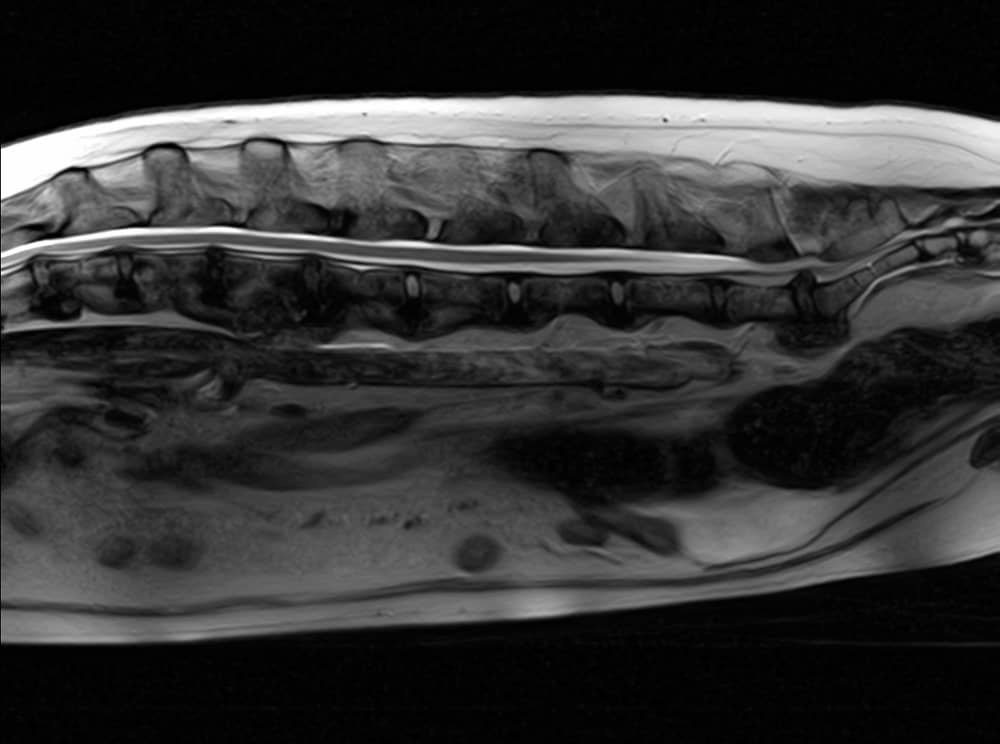
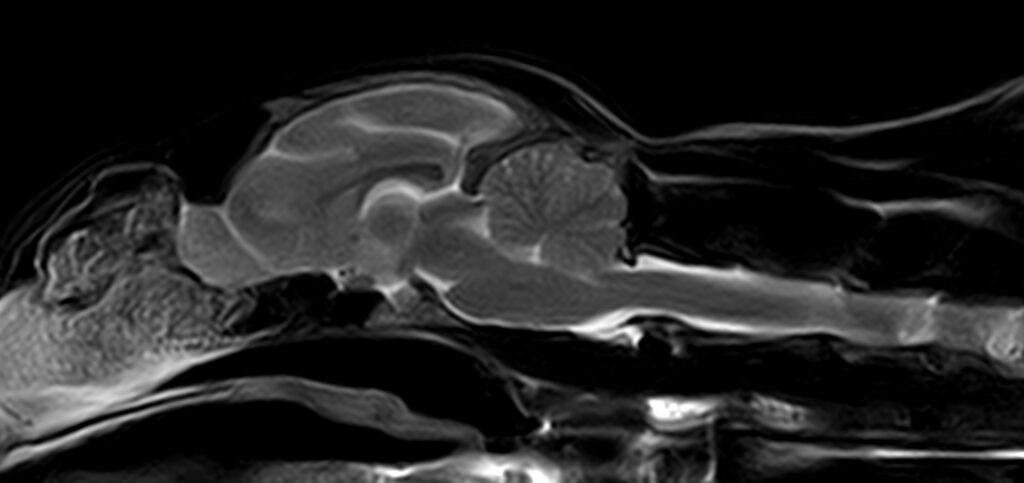
Image quality across spine, brain and soft tissue has consistently been validated by independent clinical users and published case evidence. The system produces the detail needed for confident diagnosis of the conditions that drive MRI referrals: seizures, disc disease or herniations, brain tumors, strokes and complex orthopedics.
And the technology continues to advance. Hallmarq’s commitment to innovation is reflected in its ongoing AI development program, which is already delivering results in equine imaging, and is being applied to the small animal platform. AI-enhanced imaging, using advanced denoising algorithms, reduces scan times while maintaining or improving image quality.
For a practice managing a busy caseload, that translates directly into more cases per session, less time under anesthesia per patient and more efficient use of your clinical team’s time.
6. “What Does the ROI Actually Look Like?”
Just two cases per week! That’s the threshold at which the Hallmarq Small Animal 1.5T MRI system pays for itself on an Imaging-as-a-Service model. Everything above that is margin.
Beyond the direct scan revenue, the ROI calculation should include the value of cases retained in-house. It should also factor in the reputational and competitive benefit of being a regional MRI provider: the referrals you attract from primary care practices, the staff retention benefit of keeping complex cases on-site and the platform it creates for building a genuine multidisciplinary service.
MRI is not just a piece of equipment. It is a capability that changes what kind of practice you are and what kind of cases you can take on.”
Jim Catullo, Small Animal Sales Director, North America, Hallmarq Veterinary Imaging
Why Hallmarq Specifically?
The decision-maker’s case for MRI in general is strong. The case for the Hallmarq system rests on a combination of factors:
- Veterinary-specific by design. This is not a human system adapted for animals. It was built for veterinary medicine and has been refined over 25 years. With 160 system installs in 28 countries around the globe, Hallmarq customers have performed over half a million animal scans to date.
- Lower total cost of ownership. Zero helium, built-in RF shielding, modular installation and flexible finance options collectively remove the cost and complexity barriers that make conventional MRI economics difficult.
- Operational resilience. 99% uptime guarantee, remote system monitoring, on-site engineering support and Remote Operations Service combine to reduce the operational risk that decision-makers are right to price into any capital equipment acquisition.
- A genuine partner, not just a supplier. Hallmarq’s unique Q-Care customer program encompasses training, account management, marketing support for your MRI launch, access to the Hallmarq community and ongoing technical development. Importantly, the relationship doesn’t end at installation.
- A technology platform, not a static product. AI-enhanced imaging is already transforming what Hallmarq’s equine system can deliver. The same commitment to innovation is being applied to the small animal platform, meaning the system you invest in today will continue to develop in capability over its operational life.
The Decision
The clinical team wants MRI because it makes them better at their jobs. Your job is to decide whether the investment makes the practice better at its business.
With a system designed to minimize upfront cost, operational complexity and supply chain risk, backed by a 99% uptime guarantee and a flexible finance model, the Hallmarq Small Animal 1.5T MRI is built to satisfy both requirements.
So, what conversations should you be having next? Speaking with your clinical lead about realistic case volumes, and with Hallmarq about the financial model that fits your practice’s situation, should return a well-rounded case for acquisition.
To request a conversation with the Hallmarq team about the commercial and operational case for small animal MRI at your practice: INQUIRE NOW
The Hallmarq Small Animal 1.5T MRI
It’s more than an MRI: it’s an intentional approach to advanced veterinary-specific imaging.
Download our brochure today.