



If you’re responsible for capital equipment decisions at an equine veterinary practice, you’ll know that the conversation about standing MRI usually starts in the clinical team and arrives on your desk with a certain amount of momentum behind it.
The surgeons want it. The lameness specialists want it. The referring vets down the road want to know you have it.
Your job is to ask the questions they may not have fully answered:
- What does it actually cost to run, not just to acquire?
- What happens to revenue if it’s offline?
- How quickly does it pay its way?
- Does the return – across all the ways it generates value, not just the scan fee – justify the investment?
This is for you. This piece draws on Hallmarq’s standing equine MRI system and the commercial case for integrating it into equine practice, and addresses the questions that matter most at the procurement stage.
Why standing MRI and why now?
Equine lameness is one of the most clinically and commercially significant challenges in veterinary practice. It accounts for a substantial proportion of referral caseload and that caseload is now far bigger than it has been in the past, with advanced technologies enabling scans of the proximal limb that were once deemed unsuitable for standing MRI.
The ability to diagnose lameness accurately and early – rather than through repeated empirical treatment cycles – is increasingly what separates practices that attract and retain complex cases from those that refer them elsewhere.
Standing MRI is, by clinical consensus, the gold standard for imaging the equine foot. Diagnostic in over 90% of lameness cases, it identifies both bone and soft tissue abnormalities that radiography, ultrasound and CT can sometimes miss. But it’s no longer just about the foot! Crucially, as we’ll come to, the diagnostic reach of standing MRI has expanded significantly with recent technological advances.
A practice with standing MRI diagnoses with confidence. A practice without it refers out. Every case that leaves is revenue, reputation and clinical relationship that accrues to someone else.
“Advanced imaging has moved from specialist luxury to competitive necessity in secondary and tertiary veterinary care. The practices that can deliver it are pulling ahead.”
Mick Crosthwaite, CEO, Hallmarq Veterinary Imaging
The questions decision-makers should be asking
What will it actually cost us?
Cost is always the first question. But it needs to be asked about the total cost of ownership, not just the headline acquisition figure.
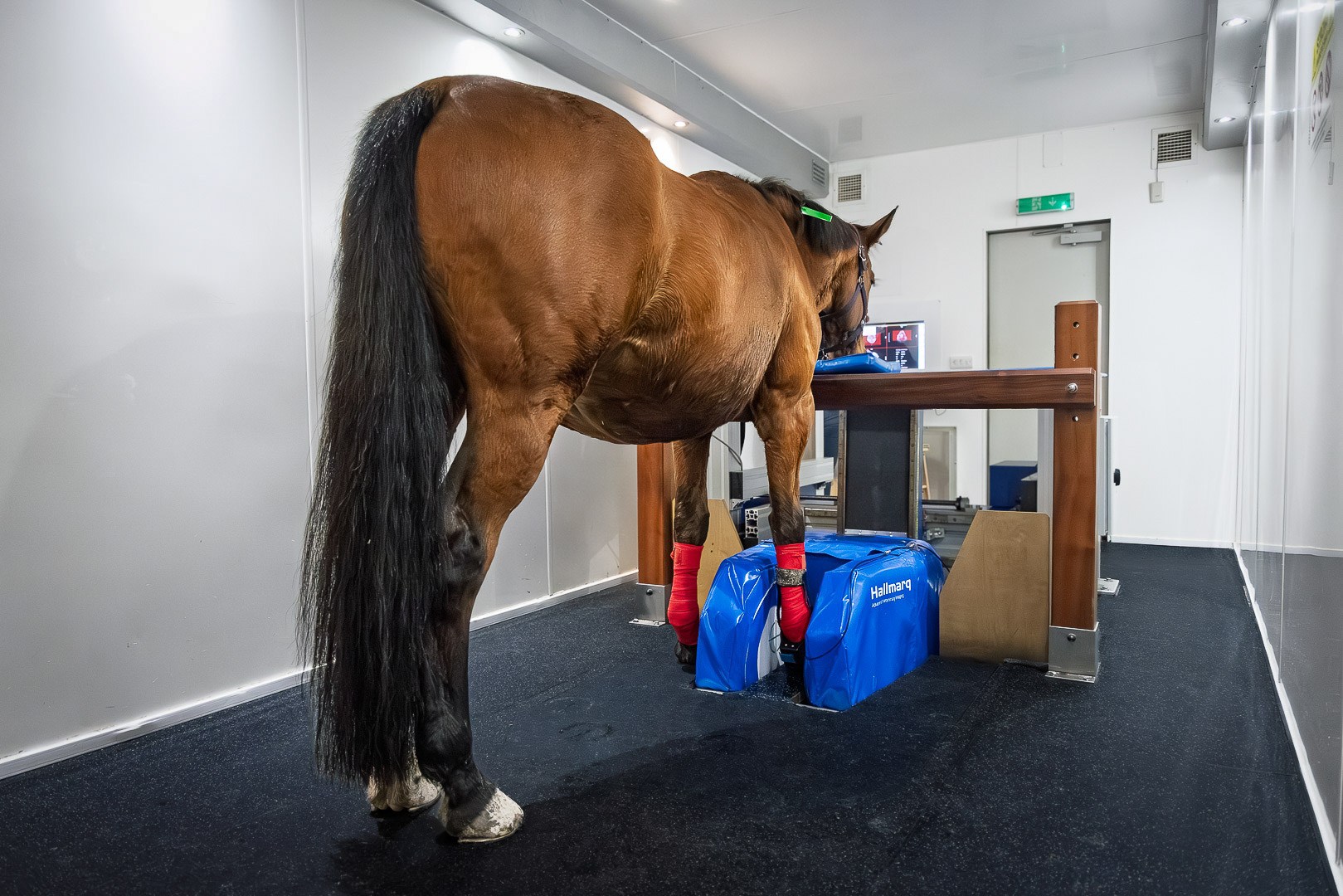
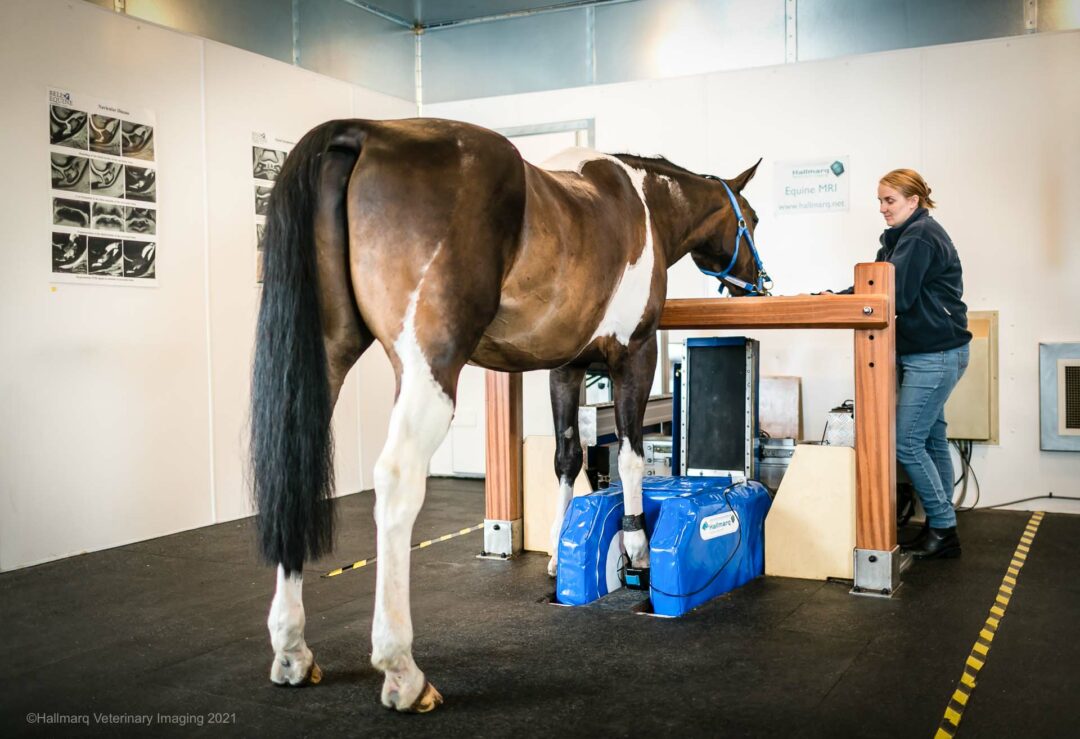
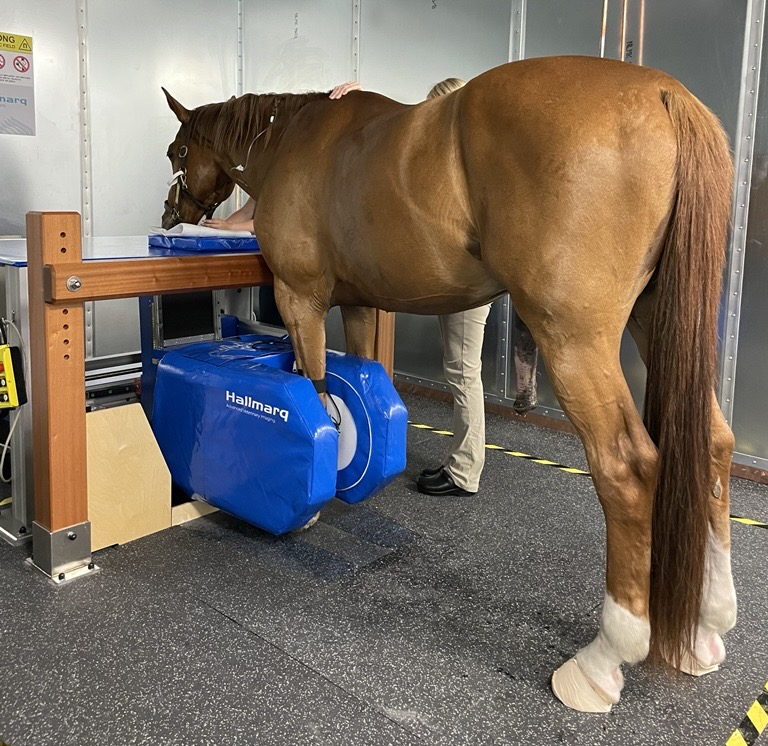
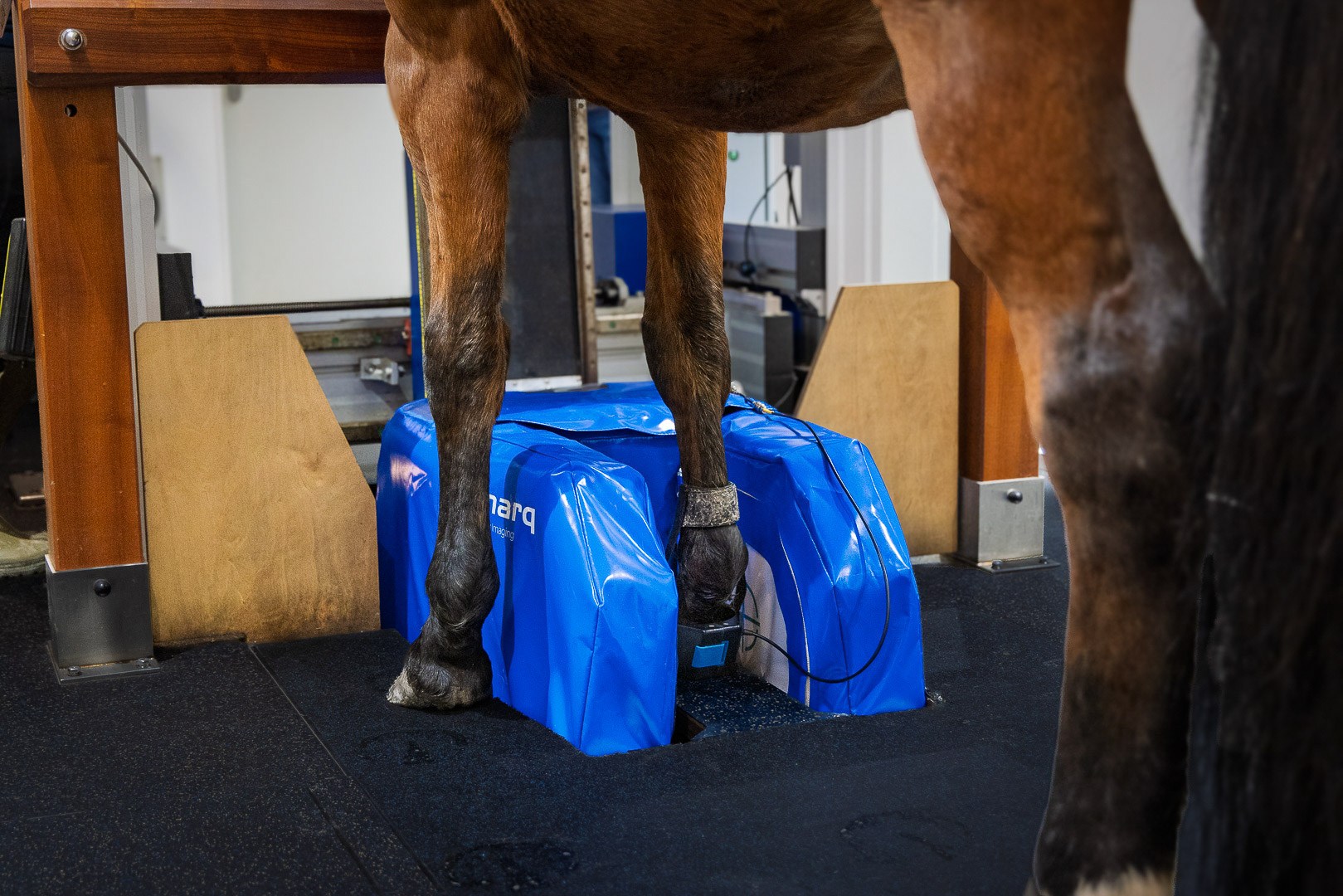
The Hallmarq Standing Equine MRI (sMRI) is a low-field (0.27T) system, purpose built for the standing, sedated horse. It does not require general anaesthesia, which removes an entire layer of cost, staffing and risk from the procedure. And, for the most part, cases can be handled on an outpatient basis, with horses dropped off and collected the same day.
On installation, Hallmarq offers two options:
The in-hospital installation: integrates the sMRI into an existing or purpose-built room within your clinic; ideal where space and adjacency to surgical facilities matters.
The modular room option: places a fully self-contained, weatherproof, RF-shielded unit externally on any hard surface at your practice. You provide power and an internet connection and Hallmarq handles the rest. For practices where capital and disruption are constraints, the modular option dramatically reduces the complexity and cost of getting operational.
What are our finance options?
Hallmarq’s pay-as-you-go model is specifically designed to reflect the seasonality of equine practice, which is a feature no other imaging provider in this space matches. Your fees flex with your caseload: in quieter months you pay less, in peak season the model absorbs the higher volume without penalty.
With approximately two cases per week, a practice can expect to reach break even. Growth in scan volume over the duration of a ten-year contract averages around 63%, based on Hallmarq’s own data across its installed base. The trajectory, once a practice establishes its sMRI service and builds referring relationships, is consistently upward.
For practices with variable cash flow or competing capital priorities, Hallmarq’s rental model removes the requirement for large upfront capital or personal guarantees. A single monthly payment covers the system, service, support and training and ongoing, unlimited software updates. For those who prefer asset ownership, capital purchase with a monthly service and support agreement is also available.
In addition, Hallmarq’s unique Q-Care customer support programme is included with both finance options; a comprehensive support and partnership ecosystem that we’ll return to in more detail below.
How big is the addressable case pool and is it growing?
This is the question that should sit at the centre of any commercial case for standing MRI and the answer has changed materially in the past twelve months.
Historically, sMRI referral criteria were shaped by a practical constraint: scanning above the coronary band was technically challenging in a standing, sedated horse and diagnostic outcomes above the foot were less consistently reliable. The foot was the primary focus; not because MRI wasn’t valuable higher up, but because consistent diagnostic quality was harder to guarantee.
That constraint has now been addressed with Hallmarq’s SEEMORE Technology:
iNAV: Hallmarq’s advanced motion correction software, tracks limb position three times per second during image acquisition and corrects for movement in real time. The proximal suspensory, fetlock, carpus and tarsus (previously areas of diagnostic uncertainty in the standing horse) now yield the kind of image quality that was previously associated only with foot scans.
pAlce: Hallmarq’s AI-enhanced imaging technology, uses advanced denoising algorithms to cut scan times by up to 75% without compromising resolution or contrast. Shorter scan times mean less sedation per patient, more cases per session and lower per-scan cost of delivery.
The commercial implication of our SEEMORE Technology is direct: the addressable pool of sMRI cases is now larger than the historic referral criteria would suggest. Practices that have been referring proximal limb cases elsewhere – or managing them without imaging – can now reconsider that approach.
Annie Makin, SVP Equine Imaging North America & Global CT/MRI
In addition, practices already operating Hallmarq’s standing MRI should be actively communicating the expanded capability to their referring networks. It’s a win-win situation for all concerned. Read more about what this means for case selection.
What does the revenue picture look like beyond the scan fee?
Standing MRI generates downstream revenue across a wide range of follow-on services. An accurate MRI diagnosis identifies the specific injury, its extent and the appropriate treatment, which means surgical and therapeutic interventions can be planned with confidence rather than guesswork. Stem cell therapy, arthroscopy, rehabilitation programmes, repeat imaging to monitor healing, second-opinion services for complex cases; all of these flow directly from an sMRI diagnosis.
Practices that offer sMRI also build referral networks that generate volume beyond their existing client base. Local ambulatory practices, competition yards and breeding operations that previously had to send horses to a distant facility now have a local option and the relationship that builds around that is long term. A practice that becomes the regional centre for advanced equine lameness diagnosis compounds that reputation over time. The white paper analysis of scan volume growth (63% over a ten-year contract) reflects this compounding effect. The service builds on itself.
What does it do for our practice beyond the numbers?
The commercial case for standing MRI extends into areas that are harder to quantify but no less real:
- Staff retention and satisfaction: Equine vets who want to work with advanced diagnostic technology will be drawn to and stay at practices that offer it. The ability to perform and interpret quality lameness diagnostics in house is genuinely valued by clinical staff, and practices that offer it reduce the risk of losing their best people to better equipped competitors. Research published in 2025 identifies access to advanced imaging technology as a meaningful factor in equine veterinary job satisfaction and retention.
- Reputation and positioning: Being known as the practice that can diagnose what others can’t is a powerful market position. It attracts the complex, high-value cases that generate downstream revenue and clinical interest. It builds trust with horse owners who increasingly research their options and expect the same standard of diagnostic care they would expect for themselves.
- Client loyalty: When a horse owner’s animal is diagnosed accurately, treated appropriately and returns to soundness, that client stays. The alternative – multiple treatment cycles without resolution, referral to a distant facility, extended uncertainty – erodes trust even when individual treatments are competently delivered.
What happens if it goes wrong?
Unplanned downtime is the risk that decision-makers are right to probe. An sMRI system that’s offline is not just a cost centre, it’s revenue lost, clients disappointed and referring relationships strained.
Hallmarq’s Q-Care programme delivers remote system monitoring across 25 key parameters enabling early detection of issues, often before the clinical team is aware of a problem. When on-site intervention is needed, qualified Hallmarq engineers are committed to attending site within the customer’s SLA. That kind of long-term reliability is what the commercial case ultimately depends on – and it’s what Q-Care is built to deliver.
The Q-Care difference
Q-Care is worth addressing directly because it is, in our view, the most commercially significant feature of the Hallmarq proposition, and the one most likely to be underweighted in an initial procurement assessment.
Most imaging providers sell you a system. Hallmarq sells you a system with a support and partnership infrastructure that is comprehensive, in-house and included. There’s no need to source third-party engineers, external training providers, separate marketing support or outside technical consultants. Everything is coordinated through one team that understands veterinary imaging and the commercial realities of running an equine practice. Here’s what it covers:
- From the moment of first enquiry, Hallmarq provides a free feasibility study and access to in-house architectural and project planning support, so site preparation is guided by people who have done this many times.
- Through installation, Hallmarq’s team delivers on-site operator training and certification.
- Post-installation, Q-Care covers remote and on-site technical support, proactive system monitoring, software updates at no additional cost and maintenance visits as required.
- Marketing support for your sMRI launch and ongoing campaigns can be arranged
- Trained operators have access to the Hallmarq online community, peer to peer case discussions, webinars, annual user meetings and pro-active partnership reviews.
There’s a lot going on under the Q-care unbrella as Image Equine UK’s Merry Smith says:
“Hallmarq stands out as a result of their consistent and reliable personal service, their rapid response to queries and, most unusually, for their desire to teach, train, collaborate and improve on their products.”
Merry Smith, MA VetMB PhD Cert ES DipECVS AECVDI MRCVS
What’s more, Q-Care is included with both finance routes. It’s not an optional extra; every single Hallmarq customer benefits from the service.
What the decision comes down to
The clinical team wants standing MRI because it makes them better diagnosticians. Your job is to decide whether the investment makes the practice better at its business.
With a break even point of around two cases per week, a finance model that flexes with caseload seasonality, a case pool that has grown with the expansion of diagnostic capability above the foot, and a support infrastructure that is industry leading and fully included, the commercial case for standing equine MRI is strong.
The conversations worth having next are with your clinical lead about realistic case volumes and referring network relationships, and with Hallmarq about the finance model and installation option that best fits your practice.
With 25 years of experience and 138 Standing Equine MRI machines installed around the world, we know what works!
Get in touch to request a conversation with the Hallmarq team about the commercial and operational case for standing equine MRI at your practice:
Download the full white paper here
The Value of Standing Equine MRI